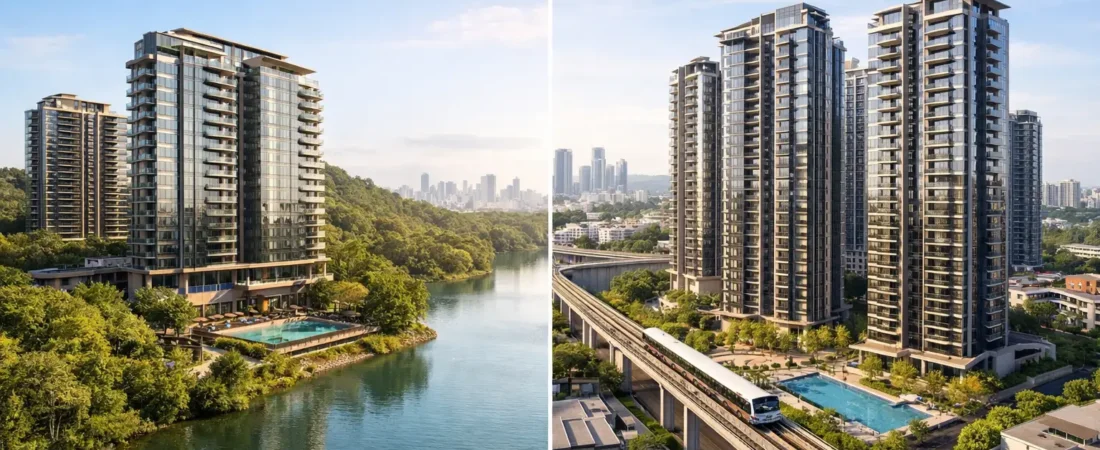
If you are weighing thomson reserve versus lentor, you are likely not choosing between two identical neighborhoods with different price tags. You are choosing between two different living environments in the northern-central part of Singapore – one established, greener, and more private in feel, the other newer, more connected to fresh development activity, and increasingly shaped by large-scale transformation.
That distinction matters for both homebuyers and investors. In Singapore property, a short distance on the map can still produce very different outcomes in daily convenience, rental demand, resale liquidity, and the kind of home environment you get over the next five to ten years.
Thomson Reserve versus Lentor: the core difference
The simplest way to frame Thomson Reserve versus Lentor is this: Thomson Reserve generally appeals to buyers who want a mature, lower-density landed or landed-adjacent residential setting with a quiet, established character. Lentor tends to appeal to buyers looking at the next phase of neighborhood growth, especially where new condominiums, improved transport access, and a planned residential cluster can create momentum.
Neither is automatically better. It depends on whether your priority is immediate neighborhood maturity or future area evolution.
Thomson Reserve sits closer to the Upper Thomson and central-eastern edge of the Thomson catchment where greenery, established housing stock, and a more tucked-away residential atmosphere shape buyer perception. Lentor, by contrast, has become one of the clearer examples of a modern new-launch micro-market. Buyers looking there are often assessing not just one project, but the broader pipeline of homes and amenities building up around Lentor MRT.
Location and connectivity
For many buyers, location starts with commute time rather than district labels. That is where the two areas begin to separate.
Thomson Reserve offers access to major roads and sits within reach of the Thomson corridor, but the experience can feel more residential and car-friendly depending on the exact property. If you value a quieter arrival home and do not mind relying a little more on driving or short feeder connections, that can be a positive rather than a drawback.
Lentor has a more obvious public transport story. With Lentor MRT on the Thomson-East Coast Line, the area has a clearer rail-led identity, which matters to both owner-occupiers and investors. For buyers who want straightforward train access into the city and across connected nodes, Lentor has a practical edge.
That said, connectivity is not only about MRT distance. Thomson Reserve can still work very well for households that prioritize road access, school runs, and a calmer residential environment over being in the middle of a higher-density transit cluster.
Neighborhood character and lifestyle
This is often where the decision becomes clearer.
Thomson Reserve tends to feel more settled. The greenery is part of the appeal, and the area can suit buyers who want a home-first environment rather than a launch-driven district. The lifestyle is more about privacy, a mature streetscape, and proximity to established enclaves rather than the excitement of a newly built residential hub.
Lentor feels more transitional, but in a way many buyers like. The area is being shaped by new projects, new residents, and expanding amenities. For some, that means buying into a district with upside. For others, it means living through a period where the neighborhood identity is still forming.
If you prefer immediate charm and established calm, Thomson Reserve may feel more convincing. If you are comfortable with a newer urban environment that is still filling out, Lentor has a stronger case.
Housing stock and buyer profile
Another key point in thomson reserve versus lentor is the type of property you are actually comparing.
In Thomson Reserve and nearby pockets, buyers may encounter landed homes, older private residences, and properties with more distinctive layouts or larger plots. These homes can offer space and exclusivity, but they may also come with higher maintenance expectations, older design language, or pricing that reflects rarity rather than pure efficiency.
Lentor is more closely associated with new-launch and newly completed condominium interest. That usually means more modern facilities, layouts aligned with current buyer preferences, and developer-led presentation that feels easy to assess. For first-time private homebuyers or investors who prefer newer stock, Lentor can be simpler to understand and compare.
This difference shapes buyer demand. Thomson Reserve may attract a narrower but more lifestyle-driven buyer pool. Lentor may appeal to a broader group, especially younger families, upgraders, and investors who are comfortable evaluating projects within a larger new-launch cluster.
Pricing, value, and what buyers are really paying for
Price per square foot is useful, but it does not tell the full story.
In Thomson Reserve, buyers may be paying for land value, neighborhood exclusivity, and low-density surroundings. That can make headline pricing look high relative to age or finish if you judge the property purely on modern specifications. But buyers in these locations are often paying for scarcity and setting.
In Lentor, pricing often reflects launch momentum, transport accessibility, and confidence in the district’s growth story. Buyers are paying not just for the unit itself, but for the convenience of newness and the belief that the area will become more complete over time.
The trade-off is straightforward. Thomson Reserve can offer stronger lifestyle differentiation but may be less standardized in value comparison. Lentor can be easier to benchmark against nearby projects, but because several developments may compete in the same broader micro-market, buyers need to think carefully about future resale competition.
Investment angle and resale prospects
For investors, the comparison is less about which area sounds more premium and more about who the next buyer or tenant is likely to be.
Lentor has a clearer rental and resale narrative for tenants and buyers who prioritize MRT access, modern facilities, and new inventory. This can help with marketability. When a unit is easy to explain in one sentence – near MRT, new condo, growing area – it often reaches a wider audience.
But there is also a caution. When multiple new projects launch in the same area, investors may face overlapping competition at resale or lease-up stages. That does not remove Lentor’s appeal, but it does mean project selection matters. Stack orientation, layout efficiency, entry price, and completion timing can all affect returns.
Thomson Reserve can be more niche from an investment standpoint. Rental demand may be less broad-based, but the right property can attract tenants or buyers looking for a quieter, more exclusive residential setting. Resale performance may depend more on property-specific qualities and less on mass-market project momentum.
In short, Lentor may offer easier marketability. Thomson Reserve may offer stronger differentiation. Which one performs better depends on the asset, not just the postcode.
Family considerations
For owner-occupiers, family fit often outweighs pure investment logic.
Thomson Reserve can appeal to families who want more breathing room, a calmer environment, and a neighborhood that already feels established. If your ideal home life includes quieter streets and a stronger sense of retreat, this area deserves serious attention.
Lentor may work better for families who value convenience, access to transit, and newer condo facilities. Parents who want a practical daily routine with less friction may find the area easier to live in, especially as amenities continue to build out.
School preferences, commute patterns, and household lifestyle matter here. A family with two working parents and no car may lean toward Lentor. A family prioritizing privacy and long-term residential comfort may prefer Thomson Reserve.
Which one makes more sense right now?
If you are comparing Thomson Reserve versus Lentor today, a useful test is to ask what you want your purchase to do.
If you want a home in a mature environment with a more distinctive residential feel, Thomson Reserve stands out. It is better suited to buyers who are less concerned about being in the newest launch cluster and more concerned about atmosphere, privacy, and long-term livability.
If you want exposure to an area with visible growth, strong MRT-led convenience, and a more active new-launch ecosystem, Lentor is likely the stronger fit. It suits buyers who value modern product, easier comparison across projects, and a district narrative built around expansion.
For many buyers following launch activity on platforms like Singapore Property Preview, Lentor will naturally feel more visible because it is tied to current development momentum. But visibility is not the same as suitability. The better choice is the one that matches your holding period, lifestyle needs, and tolerance for neighborhood change.
A good property decision rarely comes from choosing the area with more buzz. It usually comes from choosing the area that still makes sense after the excitement fades.