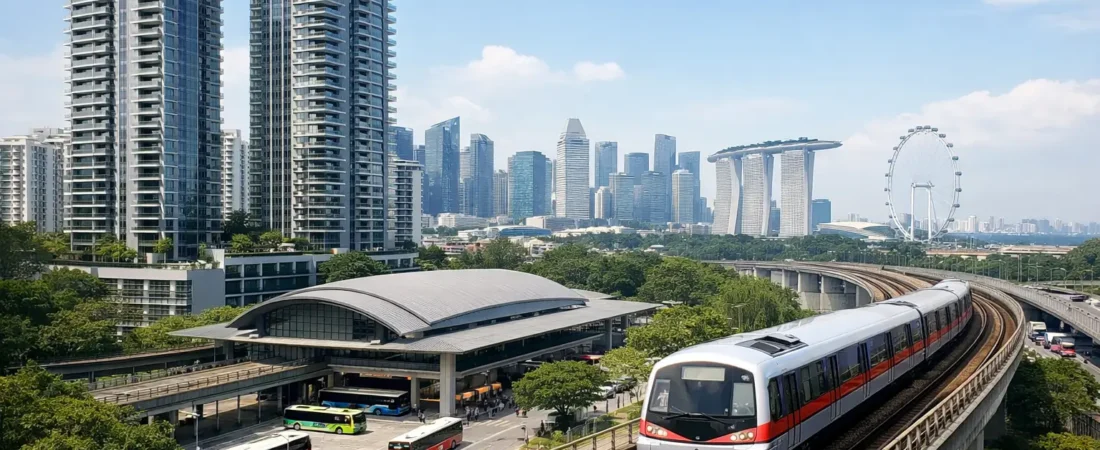
A three-minute walk to an MRT station can shape far more than a daily commute. It can affect a household’s routine, a tenant’s shortlist, and the long-term appeal of a new condominium. That is why top launches near transport hubs consistently draw close attention in Singapore, particularly when they combine rail access with shops, schools, employment centers, or established neighborhood amenities.
For buyers, proximity to transport is easy to understand but harder to assess properly. A development may be marketed as near an MRT station, yet the actual walk may involve sheltered or unsheltered paths, road crossings, elevation changes, or a crowded station entrance. The strongest opportunities are not simply the closest projects on a map. They are homes that make the wider city easier to use while still fitting a buyer’s budget, lifestyle, and holding horizon.
Why transport-led launches command attention
Singapore’s rail network gives buyers a practical way to compare locations across very different districts. A home near an interchange can offer direct access to several parts of the island. A project on an established line may provide a reliable route to the CBD, one-north, Changi Business Park, or major education clusters. For owner-occupiers, that can mean less time spent transferring between buses and trains. For investors, it broadens the potential tenant pool.
Transport access also supports resale visibility. When future buyers begin their search, many start with a station name or a preferred commuting radius. Projects near recognizable MRT stations are easier to place in that search. This does not guarantee price growth, and buyers should be cautious about paying any premium without comparison, but it can provide a meaningful layer of demand.
The premium varies by location. A compact city-fringe project near an MRT station may appeal to professionals who value speed and convenience. A suburban launch near a transport hub may attract families looking for larger homes, neighborhood services, and access to schools. The same “near MRT” label can therefore represent very different buying propositions.
What qualifies as a transport hub?
Not every station has the same influence on a development’s appeal. A single-line station can be highly useful when it offers a direct route to key destinations. However, an interchange or integrated transport node often has added value because it connects rail lines, bus services, retail, dining, and daily necessities in one area.
Examples include locations around Bishan, Buona Vista, Bugis, Jurong East, Paya Lebar, Serangoon, Tampines, Toa Payoh, and Woodlands. Each serves a different buyer profile. Buona Vista has strong links to one-north and education institutions, while Paya Lebar combines city-fringe access with commercial activity. Jurong East and Woodlands are major regional centers, where the appeal extends beyond the MRT platform to healthcare, malls, offices, and future transformation plans.
Buyers should also look beyond existing rail infrastructure. Announced lines and stations can improve future connectivity, but the timing matters. A project may be completed years before a planned station opens. That does not make the location unattractive, but it means purchasers should distinguish between convenience available on day one and convenience that remains a longer-term possibility.
Top launches near transport hubs: how to compare them
When reviewing new launches around MRT stations, start with the walking experience rather than the marketing distance. A 400-meter route that is direct, shaded, and safe may feel more convenient than a shorter route across major roads. Visit at peak hours if possible. This reveals queue conditions, foot traffic, traffic noise, and the practical route from the station exit to the development site.
Next, consider the type of transport access. A project near a station on the North-South Line, for example, may suit buyers commuting toward Orchard or Raffles Place. A home close to an interchange can be more flexible for households with different work and school destinations. Directness often matters as much as total journey time.
Then assess what surrounds the station. Some transport hubs are active throughout the day, with malls, hawker centers, supermarkets, clinics, and bus interchanges nearby. Others are more functional than lifestyle-oriented. Neither is automatically better. Families may prefer a quieter setting with everyday amenities nearby, while investors may prioritize a livelier area with employment demand and late-evening convenience.
Price should be examined at the project level, not only by district. Compare the launch price against nearby resale condominiums, recently completed new developments, and other available new launches with similar connectivity. A higher price may be justified by newer facilities, stronger finishes, better site planning, or a more direct route to the MRT. It may be less compelling if the project is relying mainly on a broad transport-access narrative.
The trade-offs buyers should expect
Living close to a transport hub is not a universal advantage. The same connectivity that makes a location convenient can bring heavier traffic, pedestrian activity, bus noise, and a denser urban feel. Lower-floor units facing main roads, stations, or bus interchanges may require extra scrutiny. Site visits during weekday mornings, evenings, and weekends can provide a more realistic picture than a quiet sales-gallery appointment.
Unit orientation deserves attention as well. In a station-adjacent development, some stacks may face rail tracks, commercial buildings, or busy junctions. Others may be set back toward internal landscaping or quieter residential streets. Buyers should not assume every unit within the same project has equal privacy, view quality, or noise exposure.
Another trade-off is space. Projects near established MRT hubs are often located on valuable land, which can translate into more compact unit sizes or higher price points. For a buyer who works remotely several days a week or has young children, a larger home farther from the station may be the better fit. The right decision depends on how often the household will use public transport and what it is giving up to secure that location.
Owner-occupier and investor priorities are not identical
For owner-occupiers, the best launch near a transport hub is usually one that reduces friction in everyday life. Look at commuting routes, nearby childcare and schools, grocery options, parks, medical services, and whether the area still feels comfortable after office hours. A station nearby is valuable, but it should support a neighborhood you will enjoy living in.
Investors should focus on tenant demand, competing supply, and exit options. Properties near employment nodes, tertiary institutions, or interchanges may attract a wide range of tenants. Yet rental appeal also depends on unit layout, furnishing potential, and the number of similar new homes completing in the same period. A small unit near an MRT station may be easy to explain, but it is not automatically the strongest investment if many comparable units enter the market together.
For expatriate tenants, direct access to workplaces and established lifestyle amenities can be especially relevant. For local tenants, proximity to family, schools, and familiar neighborhood services may carry equal weight. Understanding the likely occupier is more useful than relying on a generic claim that MRT access drives rental demand.
Questions to ask before registering interest
Before committing to a new launch near a transport hub, clarify the exact route to the station and the line connections available. Ask for the development’s expected completion date, identify any planned construction around the site, and review the unit stack plan carefully. If an integrated mall, future rail line, or precinct upgrade is part of the proposition, verify the expected timeline and whether it is confirmed.
It is also worth comparing journey times, not just distances. Try the route from the station to your workplace, your children’s school, or the places you visit most often. A location that looks central on a map may still require inconvenient transfers. Conversely, a non-central district with a direct train line may be more practical for your routine.
The most attractive transport-connected launches are those where convenience is visible in daily use, not merely in a brochure. Track new project announcements, compare their site plans and pricing context early, and give yourself enough time to judge whether the hub serves your life as it is likely to be lived. The right station is the one that makes your next home easier to reach, easier to enjoy, and easier to hold with confidence.