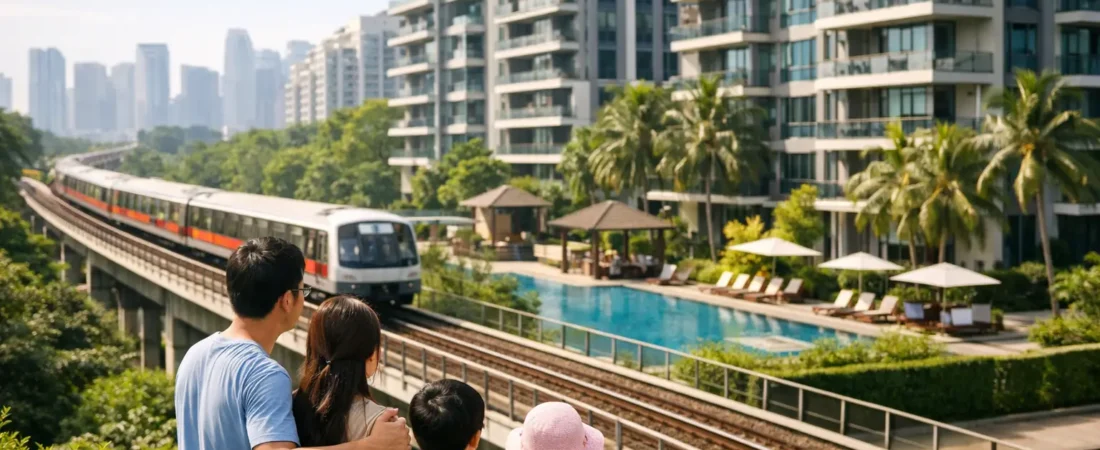
School drop-offs, grocery runs, enrichment classes, and daily commutes put real pressure on a family home. That is why the search for the best family condos near MRT usually starts with convenience, but it should not end there. In Singapore, the right project also needs enough livable space, practical facilities, and a location that still works for your household a few years from now.
For families, MRT access is not just about getting to the CBD faster. It can mean less reliance on one car, easier travel for older children, more flexibility for grandparents, and stronger rental appeal if plans change later. Still, a condo beside a station is not automatically a good family buy. Some projects trade away unit size, quiet surroundings, or school access in exchange for a shorter walk to the platform.
What makes the best family condos near MRT
A family-friendly condo near MRT tends to perform well across four areas. First is true transport convenience. That means a walkable route to the station, not just a marketing claim based on distance. Covered walkways, traffic crossings, and how manageable the route feels with strollers or young children all matter.
Second is the unit mix. Families usually benefit more from efficient three-bedroom and four-bedroom layouts than from headline amenities. A development can have an impressive pool deck, but if the bedrooms are tight or the living area is awkward, daily life gets harder quickly.
Third is the neighborhood ecosystem. Parents often look beyond the station itself to ask practical questions. Is there a supermarket nearby? Are there clinics, childcare options, parks, and food choices that work on weekdays? Is the area mostly investor-driven, or does it already support owner-occupier family life?
Fourth is long-term resilience. This includes access to schools, future transport improvements, and whether the development is in a location with sustained housing demand. Buyers who start as owner-occupiers may later become landlords, so the project should still hold broad appeal.
8 developments worth shortlisting
These are not ranked as a universal top eight for every household. They are better seen as strong examples of what families often prioritize when looking for condo living with MRT convenience.
The Orie
The Orie stands out for buyers focused on central access without giving up day-to-day practicality. Its Toa Payoh location places it within one of Singapore’s most established residential towns, which matters for families who want proven amenities rather than waiting for a neighborhood to mature.
The MRT draw here is obvious, but the larger appeal is the surrounding ecosystem. Toa Payoh already has schools, food options, retail, and healthcare within a familiar HDB town framework. That gives families a more grounded living environment than projects in purely commercial pockets. The trade-off is pricing. Central, mature-town convenience usually comes at a premium, so value depends on whether your household will fully use that location advantage.
Lentor Mansion
Lentor Mansion suits buyers who want a quieter residential atmosphere while still staying connected by rail. The Lentor area has become one of the more closely watched family-oriented new launch zones because it combines new stock with a greener, less dense feel than many city-fringe options.
For families, that balance can be attractive. The MRT connection helps with access, but the neighborhood does not feel overly urbanized. The main question is pace. Some buyers prefer mature estates with immediate depth in amenities, while others are comfortable with an area that is still evolving. If you value calm surroundings and are willing to bet on the district’s growth, this type of project can make sense.
J’den
J’den is one of the clearest examples of transport-led convenience. For families who want direct integration with a major regional center, Jurong East is difficult to ignore. MRT interchange access, shopping, and commercial activity all support a more connected lifestyle.
The reason families look here is not only current convenience but also the broader transformation story in the west. That said, integrated or highly connected projects can come with a more fast-paced urban environment. Some households will love the ability to get almost everything done nearby. Others may find that they prefer a quieter setting for young children.
Sora
Sora is relevant for buyers comparing family space against direct city-fringe pricing pressure. The western location may not appeal to every buyer, especially if daily routines are concentrated in central or eastern Singapore, but it can work well for families seeking newer homes with a more measured environment.
Its appeal depends on how your household defines convenience. If being near MRT means having reliable access without needing a prime district address, developments like this become more competitive. The bigger upside is often value per square foot and a more livable family rhythm. The downside is that commute times may still feel longer depending on your workplace and school routes.
Watten House
Watten House is a different proposition. It is less about mass-market transport convenience and more about combining a premium residential setting with access to MRT and strong educational catchments nearby. For some families, especially those prioritizing school adjacency and low-density surroundings, that formula is more compelling than being right above a station.
This kind of project tends to attract buyers who already know the district well. The family case is strong if budget allows, but it is not the right fit for everyone. Buyers chasing maximum transport efficiency or value may find better options elsewhere.
Emerald of Katong
Emerald of Katong appeals to families who want east-side lifestyle benefits without stepping too far away from rail connectivity. Katong remains one of the more distinctive residential areas in Singapore, with a blend of dining, heritage character, and access routes that keep it relevant for both owner-occupiers and investors.
For families, the area has real advantages, especially if you value established amenities and a neighborhood identity that goes beyond a single mall cluster. The trade-off is that lively districts can also bring more traffic and activity. Some families see that as energy and convenience. Others may prefer a more contained suburban setting.
Parktown Residence
Parktown Residence deserves attention because Tampines already functions as a fully developed regional hub. For families, that is often a major plus. MRT access is useful, but the stronger story is the depth of nearby amenities, schools, retail, and services that support everyday life.
This is the kind of location where errands can be consolidated efficiently, which becomes more valuable once children start school and schedules become tighter. The key consideration is competition. Well-located family developments in mature regional centers tend to attract broad demand, so buyers need to assess launch pricing carefully rather than assume convenience always equals value.
Grand Dunman
Grand Dunman is worth including because it combines city-fringe access with family usability in a way that many buyers actively search for. It benefits from a connected location that supports commuting while still sitting within an area with residential depth.
The family appeal comes from balance. You are not buying only a central address, and you are not moving too far out for space. Projects in this category often attract both owner-occupiers and investors, which can be positive for future liquidity. Still, buyers should pay attention to layout efficiency and stack selection, since not every unit type in a large development will feel equally family-friendly.
How to compare family condos near MRT without overpaying
The easiest mistake is to compare projects only by walking distance to the station. Families should compare total daily friction instead. A condo that is slightly farther from MRT but closer to schools, groceries, and weekend amenities may perform better in real life than one with a shorter train walk and a less practical setting.
It also helps to separate current needs from five-year needs. A couple with a toddler might think a compact three-bedroom is enough today, then feel the strain once children grow, a helper moves in, or one parent works from home more often. The best family condos near MRT are usually the ones that still make sense when household routines become more complex.
Price should be judged against function, not just district. A premium can be justified if the development solves multiple family requirements at once, such as transport, school access, and unit livability. But if you are paying mainly for a fashionable location while compromising on layout or livable space, the value case weakens.
A practical shortlist mindset
When buyers review the best family condos near MRT, the strongest shortlist usually includes a mix of profiles rather than one type of project. You may want one mature-town option, one city-fringe choice, one integrated or regional-center development, and one quieter suburban alternative. That gives you a more realistic comparison across price, lifestyle, and long-term fit.
For readers following new launch activity through platforms like Singapore Property Preview, this matters because market momentum can push attention toward whichever project is newest or most heavily discussed. Families usually benefit from slowing that process down just enough to test whether the project supports everyday living, not just launch excitement.
The right choice is rarely the condo with the shortest route to the station. It is the one that makes family life feel more manageable on an ordinary Tuesday.